
Restaurant SEO: The Complete Guide for Independent Restaurant Owners
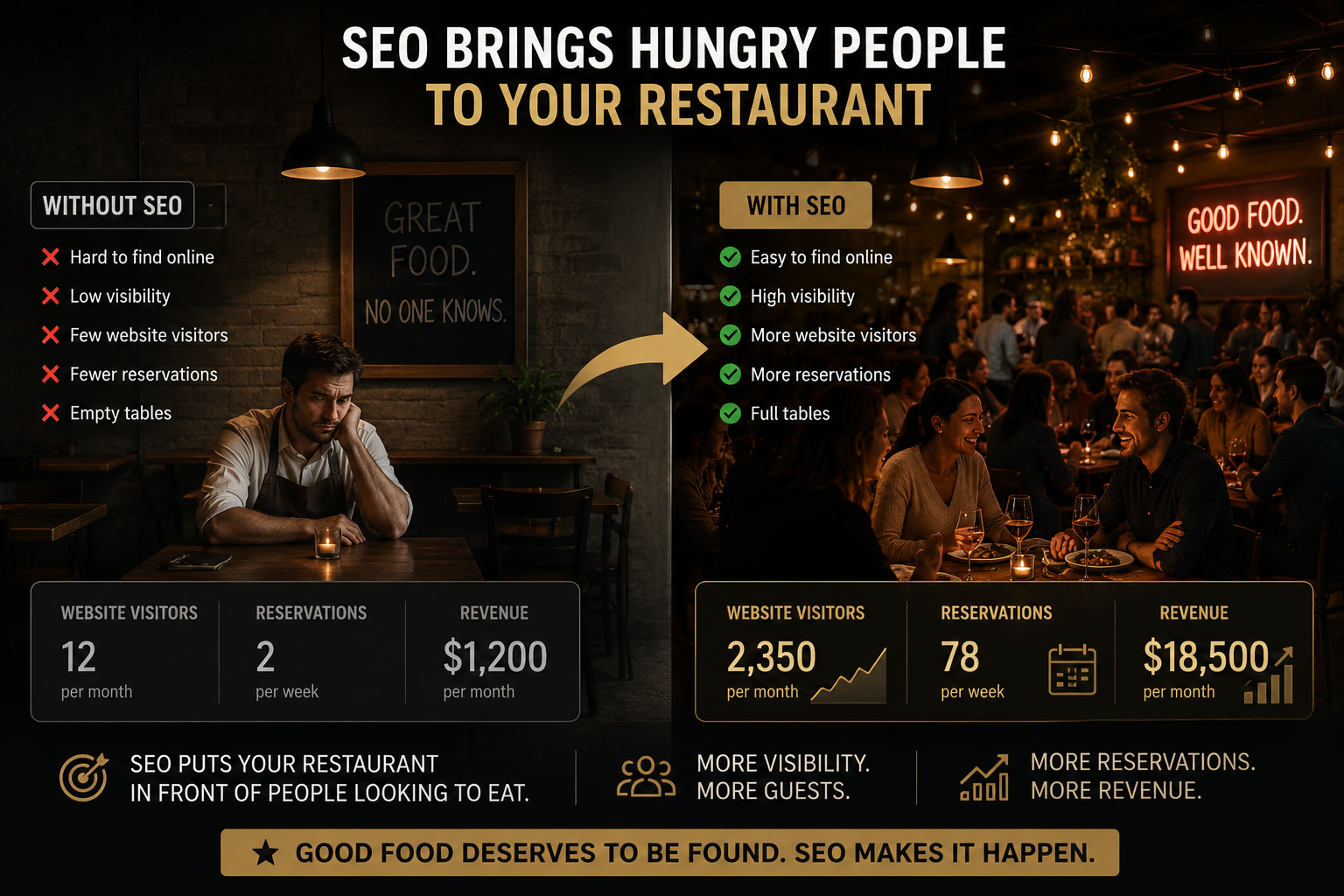
If you run an independent restaurant and you are not showing up on the first page of Google, you are losing customers every single day to competitors who are. Restaurant SEO is the single most important marketing investment a restaurant owner can make in 2026, and most independent operators have never touched it.
This guide breaks down exactly what restaurant SEO is, how it works, and what a real strategy looks like for an independent restaurant competing in a local market.
What Is Restaurant SEO?
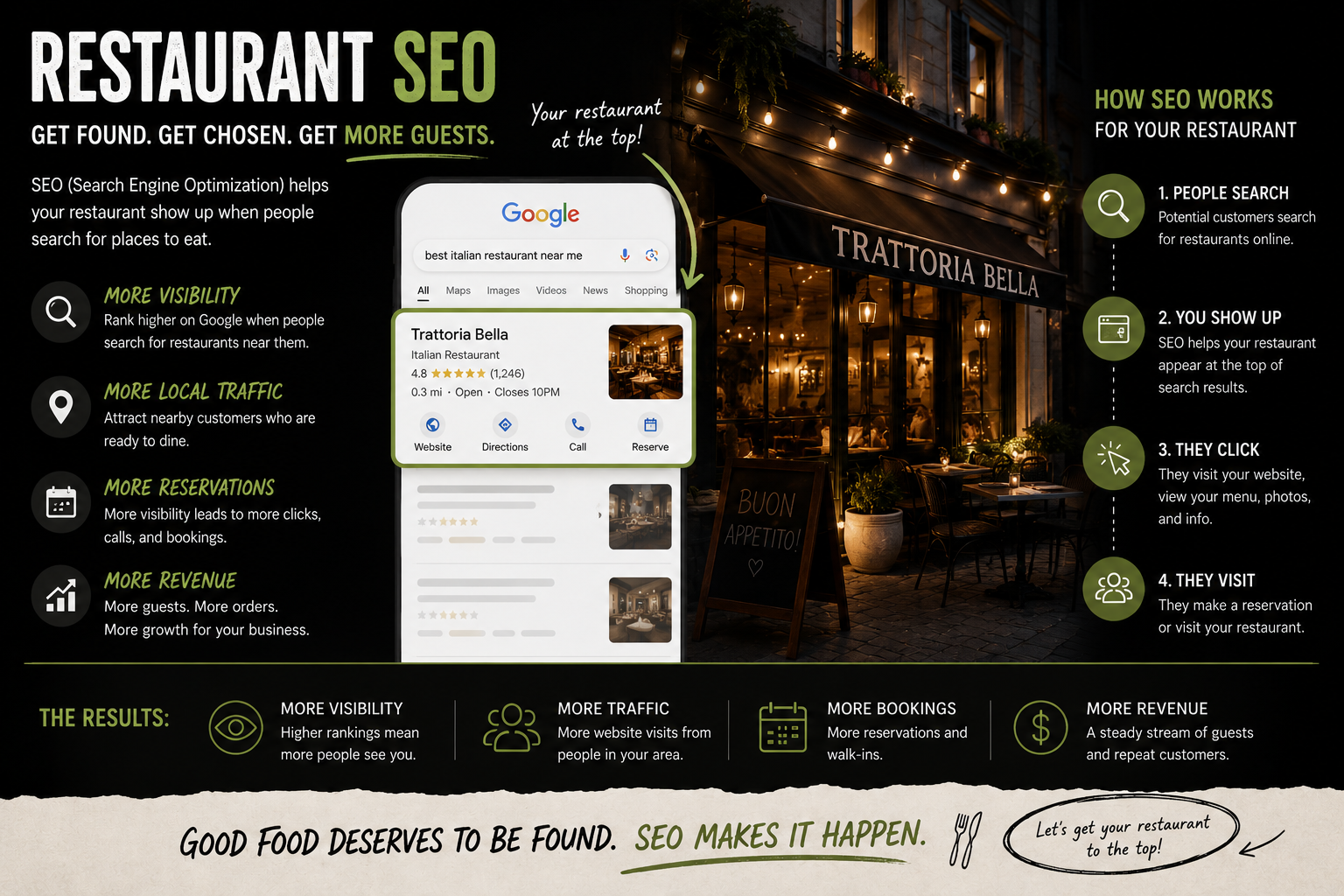
Restaurant SEO, or restaurant search engine optimization, is the process of making your restaurant visible in Google search results when potential customers are looking for a place to eat. When someone types pizza near me, Italian restaurant in Torrington, or best brunch spots in Simsbury, Google pulls from hundreds of signals to decide which restaurants to show and in what order.
Most of those signals are things you can control. Your website structure, your content, your Google Business Profile, your backlinks, your photos, your reviews. Restaurant SEO is the process of optimizing all of those signals so Google shows your restaurant to more people who are ready to eat.
Why Restaurant SEO Matters More Than Social Media
Social media posts disappear in 24 hours. A well optimized restaurant website compounds over time. Every page you build, every keyword you rank for, every backlink you earn, stays working for you around the clock without you paying for it again.
Consider what happens when someone is hungry and searching for somewhere to go tonight. They are not scrolling Instagram. They are typing into Google. Studies consistently show that over 90% of consumers use search engines to find local businesses before visiting them. For restaurants specifically, that number is even higher because the intent is immediate. When someone searches for a restaurant, they are usually ready to go within the hour.
Restaurant social media builds awareness. Restaurant SEO captures intent. Intent converts at a far higher rate than awareness, which is why investing in local SEO for restaurants produces a return that social media simply cannot match.
Local SEO for Restaurants vs General SEO
General SEO is about ranking for broad terms nationally or globally. Local restaurant SEO is about ranking in your specific geographic market, which is where the real opportunity is for independent operators.
When Google shows results for a local search, it displays what is called the Map Pack, three business listings that appear above all organic results with a map and star ratings. Ranking in the Map Pack for searches like restaurants near me or Italian food in Canton CT is arguably more valuable than ranking in organic results because it captures the highest intent searchers at the moment they are ready to make a decision.
Local SEO for restaurants focuses on three core areas. Your Google Business Profile needs to be complete, accurate, and actively managed with photos, posts, and responses to reviews. Your website needs local signals embedded throughout, meaning your city and region mentioned naturally in your content, your address and phone number consistent everywhere, and pages built around the specific searches your local customers are typing. And you need citations and backlinks from local sources, which signals to Google that you are a legitimate, established business in your community.
The Restaurant SEO Strategy That Actually Works
The restaurant owners who rank well on Google are not doing anything mysterious. They are doing a small number of things consistently over time. Here is the strategy that produces real results.
Start with your Google Business Profile. This is the single highest leverage item for local restaurant SEO. Fill out every field. Upload real photos of your food, your dining room, and your team. Write a complete business description with your cuisine type and location. Keep your hours accurate. Respond to every review, positive and negative. Post updates at least twice a month. Most restaurants have a Google Business Profile and have done almost none of this.
Build your website around what people are actually searching. Your homepage should make it immediately clear what type of food you serve and where you are located. Beyond the homepage, every major item category on your menu deserves its own page. If you serve brunch, there should be a page on your site specifically about your brunch menu with the word brunch appearing naturally throughout. If you serve coal fired pizza, there should be a page about coal fired pizza in your city. These pages are what allow Google to show your restaurant for searches that go beyond your name.
Earn local backlinks. A backlink is when another website links to yours. Every backlink is a vote of confidence that tells Google your restaurant is credible and worth showing to searchers. The most effective backlinks for restaurants come from local sources: local news coverage, restaurant week features, chamber of commerce listings, and websites of other local businesses that mention or recommend you. One backlink from the local newspaper is worth more than fifty from generic directories.
Generate reviews consistently. Google uses the volume and recency of your reviews as a ranking signal. A restaurant with 400 reviews and a 4.6 rating will rank above a restaurant with 80 reviews and a 4.9 rating in most cases. Build a simple system for asking satisfied customers to leave a review. A card on the table, a line on the receipt, a follow up text after an online order. Consistency over time wins.
Publish content that answers local questions. Google rewards websites that demonstrate expertise about their topic. A restaurant in Torrington that publishes a post about the best places to eat in Torrington becomes an authority in Torrington food searches. A bar in Simsbury that publishes content about craft cocktails in the Farmington Valley becomes more visible for those searches. This is not about writing for writing's sake. It is about telling Google that you know more about food in your market than anyone else.


SEO Keywords for Restaurants: How to Find the Right Ones
The biggest mistake restaurant owners make with keywords is targeting terms that are too broad. Ranking for Italian restaurant is essentially impossible for an independent operator. Ranking for Italian restaurant in Canton CT or best Italian food Simsbury Connecticut is very achievable.
The keywords that drive real business for independent restaurants fall into three categories.
Name plus location keywords are searches for your specific cuisine or restaurant type combined with your city or neighborhood. Pizza Torrington CT, brunch Avon Connecticut, coal fired pizza northwest CT. These are the searches that bring customers who are looking for exactly what you offer in exactly your area.
Near me keywords are searches like restaurants near me, best pizza near me, or Italian food near me. These are tied to the searcher's location and your Google Business Profile is the primary way you appear for them. This is why your Google Business Profile optimization matters so much.
Menu item keywords are searches for specific dishes or items. Best margarita pizza in Connecticut, wood fired pizza Hartford County, farm to table brunch Farmington Valley. These are lower volume but extremely high intent. Someone searching for the best margarita pizza in Connecticut is not browsing. They are about to get in the car.
The right keyword strategy for a restaurant starts with the name plus location searches, builds a presence for near me searches through Google Business Profile, and then over time creates content around the specific menu items and experiences that make your restaurant worth searching for.
How to Optimize Your Restaurant Website for SEO
A restaurant website needs to do two things at once. It needs to give your customers the information they came for as quickly as possible, and it needs to give Google the signals it needs to rank you for local searches.
The user experience side is straightforward. Your phone number and address need to be visible immediately. Your menu needs to be accessible in one click. If you offer online ordering or catering, those paths need to be prominent from the moment someone lands on your site. A website that forces visitors to hunt for basic information is losing customers to restaurants that make it easy.
For a deeper look at what makes a restaurant website convert visitors into guests, visit our restaurant website design service page.
The SEO side requires more structure. Every page on your site needs a title tag and meta description that includes your target keyword and your location. Your homepage needs your city name in the first paragraph of content. Your menu page should include brief descriptions of your dishes, not just names and prices, because those descriptions give Google something to read and index. Your contact page needs your full name, address, and phone number written out in text, not just embedded in an image.
Images need file names and alt text that describe what they show. A photo of your dining room saved as IMG_4821.jpg tells Google nothing. The same photo saved as private-dining-room-italian-restaurant-simsbury-ct.jpg and tagged with appropriate alt text tells Google exactly what it is and where it is.
Page speed matters. A restaurant website that takes more than three seconds to load on a phone is losing the majority of mobile visitors before they see a single menu item. Compress your images, use a fast hosting provider, and test your site speed regularly.
Restaurant Search Engine Marketing vs Organic Restaurant SEO
Restaurant search engine marketing typically refers to paid advertising, meaning you pay Google to appear at the top of results for specific searches. Restaurant SEO refers to earning those positions organically without paying per click.
Both have a role, but for most independent restaurant operators, organic SEO is the higher priority investment. Here is why.
Paid search stops the moment you stop paying. The day you turn off your Google ads, you disappear from those positions. Organic SEO compounds. A page that ranks well this month tends to rank better next month if you continue building the right signals. You are building an asset, not renting visibility.
Paid search also has a trust problem with restaurant customers. Studies show that a significant percentage of searchers skip paid results and go directly to organic listings, particularly for restaurant searches where they want to find genuinely popular local options rather than whoever paid most for the click.
That said, paid search can be useful for restaurants launching in a new market or promoting a specific event or offer where immediate visibility matters. The best approach is to invest in organic restaurant SEO as your foundation and use paid search selectively for specific campaigns on top of it.
What to Look for in a Restaurant SEO Company
If you are considering hiring someone to handle your restaurant SEO, the most important thing to evaluate is whether they actually understand restaurants. Generic SEO agencies treat a restaurant the same way they treat an accountant or a plumber. The strategies, the content, the keywords, and the local dynamics of the restaurant industry are different enough that working with someone who does not know the business will cost you time and money.
Look for an agency or consultant that has worked with restaurants specifically, can show you examples of restaurants they have helped rank, and can speak to the specific dynamics of your local market. Local knowledge matters in restaurant SEO because the searches you are competing for are hyperlocal. An agency in California managing your Connecticut restaurant account is guessing about your market. A consultant based in your region is not.
Ask specifically about their approach to Google Business Profile optimization, local backlink building, and content strategy. These are the three areas that move the needle fastest for independent restaurants. If they lead with technical jargon about schema markup and canonical tags without first talking about your Google Business Profile and local content, they are prioritizing complexity over results.
5 Loaves Marketing and Consulting specializes in restaurant SEO for independent operators in Connecticut. We combine deep knowledge of the restaurant industry with a hyperlocal approach to search that produces rankings in the markets where your customers are actually searching. Our restaurant marketing services are built around the specific needs of independent operators who need real results without corporate budgets.
Ready to Start Ranking?
Restaurant SEO is not complicated but it does take consistency and expertise. The restaurants that show up first in your market got there by doing the right things over time. The ones that are not showing up have been waiting for it to happen on its own.
If you are ready to stop being invisible in search results, we are ready to help. Our team understands restaurants from the inside and we know what it takes to rank in Connecticut's competitive local markets.
Explore our related services:
Call us at (203) 586-9472
For restaurants, Google is a critical platform to attract new customers and drive more foot traffic. Being easily found on Google ensures that locals, tourists, and anyone searching for a meal nearby will see your business front and center. Here’s a guide on how to get your restaurant listed on Google, the ways people find you through search, and essential tips to improve your SEO.